Showing posts with label Advance. Show all posts

Wednesday, September 28, 2016

Advance SC6000™ Rider Scrubber Provides Unparalleled Productivity, Sustainability and Durability

Advance, the brand known and trusted to introduce productivity-enhancing innovations in the industrial cleaning market, proudly introduces the Advance SC6000™ Rider Scrubber. Engineered to withstand the toughest cleaning challenges in distribution centers, warehouses, manufacturing plants, and more, the mid-sized SC6000 combines improved productivity and enhanced sustainability in an easy-to-use, compact machine.


More specifically, the SC6000 features a larger battery capacity for up to 30 percent greater run-time; SmartFlow™, which automatically adjusts solution flow with speed to reduce water and chemical usage by 50 percent; and an offset scrub deck to provide high-quality edge cleaning. Optional features include DustGuard™, which minimizes fugitive dust generation and provides optimal sweeping performance, and Advance’s EcoFlex™ System, which provides operators a flexible cleaning system with intuitive modes of operation to fit their needs. The SC6000 also boasts heavy-duty steel doors to protect the scrub deck from impact damage, heavy-duty bumpers, an extended-life cylindrical deck, and an impact detection system. Collectively, the SC6000’s features give operators the ability to quickly, effectively and safely clean even the most difficult environments.

“The SC6000 was specifically designed to provide the level of productivity, sustainability and durability required to reduce costs while safely and effectively cleaning the harshest industrial applications,” said Marty Makowsky, vice president of Industrial Sales at Nilfisk-Advance.

The SC6000 is available in 34- and 40-inch disc or 36-inch cylindrical models.

About Nilfisk

Nilfisk is one of the world’s leading manufacturers of professional cleaning equipment with approximately 5,500 employees and an annual turnover of EUR 918M. Based on a century of cleaning expertise, the company develops and manufactures high quality products that represent the latest technology and innovation and offer the broadest product portfolio in the industry. Nilfisk has sales companies in 45 countries around the world as well as a strong distributor network and markets and sells its products in more than 100 countries worldwide. Nilfisk is a part of the NKT Group.

Advance is a brand of Nilfisk. For more information on the new Advance SC6500, call 800-253-0367 or visit www.advance-us.com Smart Cleaning BlogTwitterFacebookGoogle+.

###

Tuesday, August 4, 2015

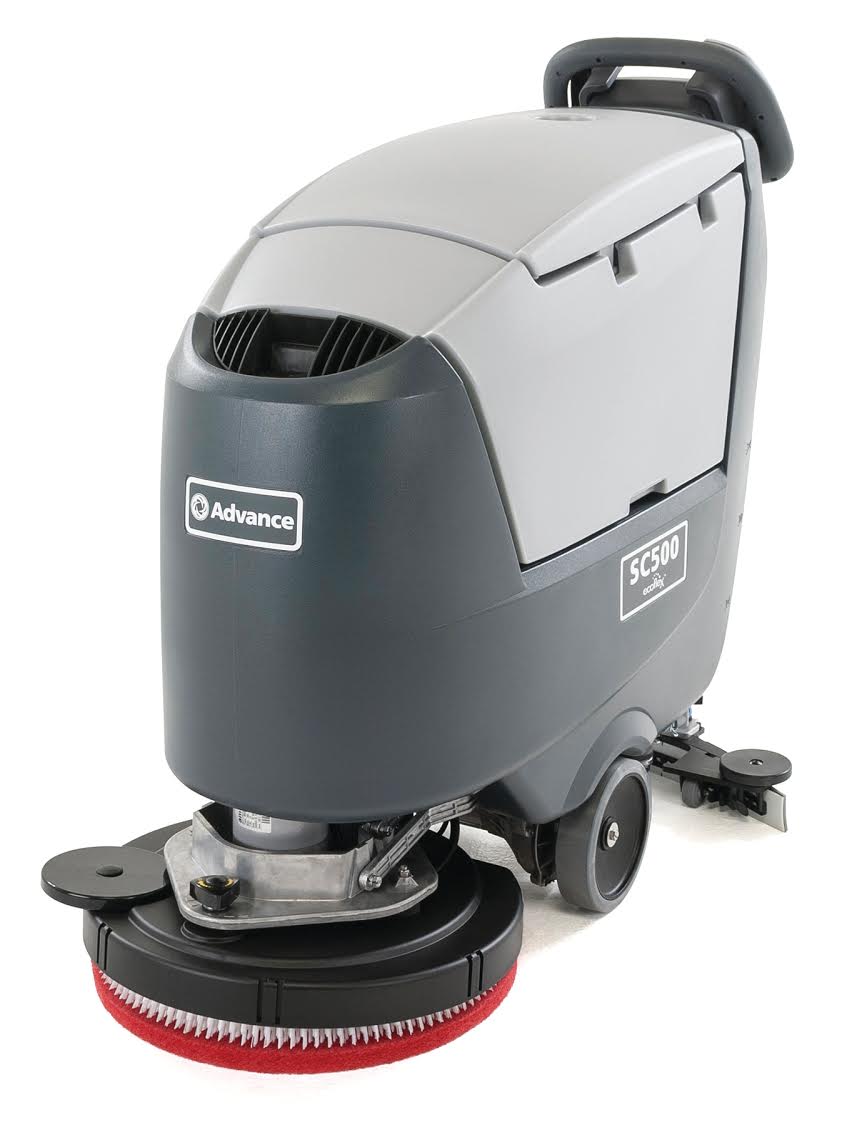
Advance SC500™ Walk-Behind Scrubber with EcoFlex™ Provides Improved Productivity and Sustainability

Advance, the brand known and trusted to introduce productivity-enhancing innovations in the commercial cleaning market, proudly introduces the Advance SC500™ Walk-Behind Scrubber. By combining efficiency, ergonomics and ease of use, the Advance SC500 is specifically designed to provide more productive and sustainable daily cleaning for a wide variety of facilities, including hospitals, schools, retailers, grocers, offices, athletic facilities, and hotels.

“Advance has a proven track record of providing our customers with cleaning technologies that meet their productivity, efficiency and sustainability needs,” said Jonathan Kingsbury, vice president of Commercial Sales with Nilfisk. “The SC500 is yet another example of that. It is ideal for cleaning professionals who need a quiet, easy-to-use walk-behind scrubber that can improve productivity and, at the same time, enhance sustainability.”


The SC500 features Advance’s innovative flow regulation system that adjusts the solution flow rate based on the machine’s speed. The system ensures consistent cleaning results, reduces water and chemical usage, and results in less downtime. The ultra quiet SC500, which operates at 63 dBA, also boasts a Quiet Mode of 60 dBA. Quiet Mode allows for true daytime cleaning in even the quietest environments. And, the SC500 includes EcoFlex, which allows the operator to effortlessly switch between chemical-free, water-only cleaning and varying degrees of detergent use.

Additional features and benefits of the SC500 include its ergonomic and easy-to-use design, such as a pressure-sensitive control panel; single-button solution, vacuum and brush deck activation; a foot pedal to engage the squeegee; and effortless propulsion, all of which make the SC500 easy for virtually any operator to use and control.


The 20-inch, 12-gallon SC500 replaces Advance’s Adfinity 20-inch scrubber line. It is available in both disc and orbital REV™ models.


Wednesday, May 20, 2015

School-cleaning Successes Worth Sharing

Whether you rely on an in-house staff or a building service contractor to clean your school’s floors, there’s never been a better time to know what successes other facility managers are experiencing and how you might improve on your own current practices. Innovation to better clean carpeted floors, improved cleaning productivity, incredible cost savings—these are just a few recent stories we’ve gathered from across the country about how Advance is revolutionizing the way schools clean.
Going soft on floors, but tough on clean.
The first school that reached out had recently started leveraging the power of the Advance ES4000™ carpet cleaner. This versatile riding machine provides a total carpet care solution, eliminating the need for multiple machines and enhancing productivity up to 400% compared to walk-behind extractors. It performs daily cleaning, low-moisture cleaning, restorative extraction and more—all at a quiet decibel level no louder than a person speaking.
For education facilities with significant carpeted space, the capabilities of the ES4000 allow you to maintain a high level of clean, even in high traffic areas. The school, in this instance, is deriving maximum benefits from the versatility of the ES4000. The multi-purpose platform allows them to use a single machine to conduct daily cleaning as well as periodic touch ups and deep extraction.     Not only will the ES4000 allow the district to maintain a healthy, clean environment for its students and faculty, it will also extend the life of the carpet—ultimately helping the district to save money.
Standing up for productivity.
The second story came from a school district that took the Advance SC1500™ standup scrubber with REV™ orbital scrubbing technology for a spin—and loved it. The REV system is known industry-wide for providing uniform, deep-scrubbing performance and even single-pass, chemical-free floor finish removal.
Reporting steadily rising levels of production—including hallways getting cleaned more frequently and dreaded floor projects becoming simpler, safer tasks—this particular facility manager has since made the SC1500 with REV a mainstay throughout the entire school district.
Getting REVved up about cost-savings and safety.
The final story came out of a school district in Texas where operation managers were also discovering the power of REV technology. With 152 classrooms in their high school, every hour of labor and gallon of chemical added up to significant costs. Fortunately, once they adopted REV equipment, things started changing right away: stripping one classroom floor went from requiring three people and 1.5 hours to one person needing only a half hour. The resulting labor savings was over 85 percent!
In addition, in the previous year there had been three slip and fall incidents, which cost the district $70,000. With REV’s chemical-free floor stripping, no such instances occurred and the district actually finished three weeks early—saving on both wages and air conditioning costs too.
Wrapping up

Schools will always prove to be challenging environments to clean: high traffic, tight turnarounds and tough budgets are only a few of the many considerations operations managers regularly make. But as a primary solutions provider for educational facilities nationwide, Advance is finding that, as more schools share their successes in best practices for cleaning, the better off everyone will be. To learn more about Advance cleaning solutions for education, visit www.advance-us.com.

Monday, June 16, 2014

Project Cleaning For Schools And Universities: Establish Time-To-Task

This article was originally published in Cleaning & Maintenance Management.

Last week, we discussed a few suggestions for project cleaning. This week, we will focus on establishing an appropriate time for each cleaning task. 

Use ISSA’s 540 Cleaning Times Book & Calculator to assess the time required for various tasks.

For example: As you prepare to strip hard floors, understand that dust mopping in classrooms is often slower than vacuuming, as the productivity of an 18-inch dust mop is less than 7,000 square feet per hour, compared to a backpack vacuum with a hard floor tool which ranges between 7,000 and 10,000 square feet per hour.

Vacuuming also removes fine, gritty soil from crevices for thorough, deep cleaning. When scrubbing floors, autoscrubbers reduce drudgery, improve results and free up human resources for other work. With a range of sizes and configurations available, there is an autoscrubber for most maintenance budgets.

This is especially meaningful when you consider that an autoscrubber consolidates a number of procedures into one — mopping, scrubbing, rinsing, squeegeeing and vacuuming — lowering costs, while providing superior cleaning and greater floor safety.

With the trend toward downsizing in large and small maintenance firms, automating floorcare is an idea whose time has come. Answering the call, manufacturers now provide autoscrubbers ranging in cleaning width from 17 inches up, with compact designs proving practical on even modest-sized floors. Hefty productivity gains allow greater floor coverage with fewer personnel and in less time compared to manual floorcare.

Floor production rates for light scrubbing with 17-inch and 20-inch scrubbers average 18,500 and 20,500 square feet per hour respectively. Actual cleaning speed will depend on usage conditions, but increases of two to 10 times over mop-and-bucket maintenance are common. There are even robotic scrubbers available for unattended floorcare, and propane-powered stripping machines for large areas needing rapid coverage.

There are also low cost dispense-and-vacuum platforms that enable dispensing floor cleaning solution, scrubbing, then vacuuming the solution off the floor and from grout lines. These enable wise use of resources on a budget.

Check back next week when we will focus on scheduling and how to work with other departments to efficiently get the job done.

Monday, June 9, 2014

Project Cleaning For Schools And Universities

This article was originally published in Cleaning & Maintenance Management.

"Well begun is half done” says the axiom, and starting projects before the need becomes critical is an important way to be sure these tasks are done while manageable.

That is why successful systems, such as team cleaning programs and the nonprofit Process Cleaning for Healthy Schools® (PC4HS) program recommend incorporating project work into weekly and monthly schedules.

For example:
  • Routine Cleaning is performed Monday through Friday and completed daily.
  • Detail Cleaning is performed in quadrants Monday through Thursday and completed weekly.
  • Project Work is performed on Fridays and completed monthly.
However, if you reserve projects for the "Big Summer Cleaning Push" — there are suggestions for making these projects easier to manage.

One thing to do is to create a task list. Otherwise, knowing what work must be done is the first step to completing it. A sample list could include:
  • Scrub, strip and refinish floors
  • Perform high dusting
  • Clean vents and grilles
  • Perform low dusting
  • Wash blinds
  • Replace lights, clean covers and lenses
  • Wash windows
  • Replace ceiling tile
  • Wash walls
  • Remove ink and other substances (e.g., chewing gum) from desks and tables
  • Clean trash receptacles
  • Clean recycle containers
  • Extract carpet
  • Clean lockers and gym mats
  • Paint walls and other areas as needed
Check back next week as we cover additional suggestions for project cleaning. 

Monday, June 2, 2014

SC1500™ REV™ Stand-On Scrubber

The SC1500™ REV™ stand-on scrubber delivers increased cleaning productivity, with up to 109 minutes of cleaning per tankful, over other stand-on scrubbers in the marketplace. With a compact, easily maneuverable design, the SC1500 allows operators to step up and start cleaning. To satisfy both daily and deep scrubbing applications, the SC1500 is available in a 20-inch REV or 20-inch disc model.

With a large 12-gallon tank capacity, low flow rate, up to 3.5-hours of battery runtime and fast operating speed, the SC1500 provides efficient cleaning performance. Requiring minimal operator training, the SC1500 features a OneTouch scrub on/off switch and intuitive dashboard controls. Additional benefits include:
  • Easy handling allows operators to simply step up, push the pedal and start cleaning
  • Uniform scrubbing with no swirl marks and floor finish removal capabilities with the SC1500 REV scrubs deeper while using far less water and chemicals
  • One pass cleaning through increased down pressure enhances cleaning productivity
  • Low noise level and silent mode enable daytime cleaning and cleaning of noise-sensitive areas
  • Sustainable cleaning is achieved with the standard, onboard EcoFlex™ System, allowing operators to effortlessly switch between chemical-free cleaning or select from weak to strong cleaning intensities
Due to its simple operation, high capacity and productive, quiet cleaning performance, the SC1500 is ideally suited for daily cleaning in hospitals and health care facilities, schools, office buildings, restaurants, shops and supermarkets.


Tuesday, May 27, 2014

Defining Cleaning Times

This article was originally published in Clean Link.

Most of us will admit that cleaning times standards are part science and part magic or art due to the many variables that cannot all be captured in a simple statement of “10 minutes per 1,000 Square Feet.” Time standards are based on as much science as possible in that a person using a stop watch times a worker performing a task utilizing prescribed equipment and chemicals on an “average” type surface.

For example, stripping a floor takes into account several time standards that when added up can be daunting at best. Does one include dust mopping, floor prep, gum removal, blocking doors, moving/replacing furniture, drying time, travel time from closet to area and myriad other tasks that may or may not be appropriate? What type machine (swing or autoscrubber) is used? How does one pick up the slurry (mop or wet vac)? What type/strength stripper is used (or even allowed due to environmental concerns)? Is the floor relatively new and well maintained? What type and how many coats of finish/seal are on the floor to be stripped? What is the humidity and temperature in the area? Is there adequate ventilation? Are you using a rotary or orbital unit to strip? What type pads are being used? How experienced are the workers in this type floor? What are the expectations of the customer as to outcomes? How much time is allowed due to traffic and safety to perform the tasks? 

Although we do not want to make stripping a floor look overly complicated, there are several questions to answer before proceeding. Please understand that there is no such thing as an “average” type floor since that is only one of the many variables that can affect the outcome. 

Monday, May 19, 2014

Advance ReliaVac™ Vacuum Line


Advance ReliaVac™single motor upright vacuums are easy to maneuver, strong on power, and designed for fast, low cost serviceability. Available in 12- and 16-inch cleaning paths, the ReliaVac gives you the power and pickup needed for all applications.

The exclusive ReliaVac vacuum green impellor fan is made from a proprietary, ultra-durable plastic and carries a lifetime guarantee. If it breaks while you have the vacuum, we will replace it at no charge.

The ReliaVac 12 and 12DC are budget-priced upright vacuums that are great for general cleaning on most any carpet pile. A steel brush roller and 50-foot power cord are featured on both models. A top-filling shakeout collector bag comes standard on the ReliaVac 12. The ReliaVac 12DC has a convenient, clear-plastic dirt cup that allows you to see when it is full. Simply remove the dirt cup and dump.

All models feature large rear wheels for easy maneuverability and a clear fan cover for ease of visibility to any blockage. The brush height is adjustable to six settings to work effectively on a variety of carpets.

Monday, May 12, 2014

The Benefits of Day Cleaning

This article was originally published in Sanitary Maintenance.

Day cleaning, or cleaning during first shift, is touted as a sensible way to save on energy costs. These savings are often too lucrative to pass up, causing many facilities to consider the switch to cleaning during daytime hours.

Day cleaning is quite popular in Europe, where more buildings are cleaned during the day than at night. For various reasons, however, the practice has not seen similar prevalence here in the United States. While day cleaning isn’t exactly non-existent, cleaning organizations are expected to embrace the practice more eagerly in the future.

In fact, industry consultants predict that within 10 years, day cleaning will be more common than traditional nighttime cleaning.

The biggest reason to clean during daylight hours, rather than in the evenings, is the energy savings from no longer needing to illuminate and heat or cool the space being cleaned. Consultants report that day cleaning can save buildings between 4 and 8 percent on energy costs, a year.

There are also a number of staffing benefits resulting from day cleaning, including:
  • Better employee retention and higher amounts of job satisfaction;
  • Increased awareness and respect of cleaning staff, who are likely doing their jobs in the presence of building occupants; and
  • Improved communication between customers and cleaning staff.
Casinos and hotels have been day cleaning for decades, but the method can be implemented in virtually any facility. The recent push for day cleaning has been largely associated with commercial offices.

Day cleaning is also popular in healthcare, especially in inpatient facilities where patients need to sleep at night without distractions, as well as in schools where janitors often work the day shift.

Monday, May 5, 2014

Advance Spectrum™ Upright Vacuum


Advance Spectrum™ upright vacuums deliver superior pickup and filtration, with the power to pull dirt and dust from carpets in a single cleaning pass, resulting in greater productivity. The 12P and 15P feature a two-stage, 1000-watt motor. Dual motors equal 20% greater productivity than single-motor uprights. The 15D and 18D add a brush motor to deliver 1,350 watts of power.

The innovative design of the Spectrum power head creates a seal with the carpet surface to agitate and capture dirt and dust that other vacuums miss. This design has earned the Carpet & Rug Institute (CRI) Seal of Approval, meeting the industry's latest pickup and filtration standards for vacuum performance.

Monday, April 28, 2014

Zone, Team or Gang Cleaning

This article was originally published in Clean Link.

Zone, Team or Gang Cleaning? What's the difference?

Zone Cleaning is the traditional way of one worker performing all (or most) of the tasks in an area. This is especially relevant in a small account that can be serviced in a relatively short period of time. Even in Zone Cleaning, how the tasks are performed, as to having an organized Job Card, can help in productivity. A fully loaded building will result in 2,500 SF/Hour utilizing this style based on the type facility and equipment.

Team Cleaning is a concept that has grown in popularity due to the effectiveness of having dedicated Specialists. Usually a team of four (Trash, Vacuum, Rest Room and Utility) will go through a building performing choreographed tasks so that each finishes at near the same time on the shift. There are many benefits to Team Cleaning including lower training times, built in quality controls and need for less equipment since each Zone Cleaner requires their own barrel, buckets, vacuum cleaners and other tools. A fully loaded building can result in 5,000 – 6,000 SF/Hour utilizing this style based on the type facility and equipment utilized.

Gang Cleaning is when a group of workers descend on an area and wander around before moving on to the next section. A well-organized Gang Cleaning team will have assigned tasks each day although I have witnessed crews arguing (and wasting time) over which tasks they have to do. A fully loaded building can result in a wide range of productivity since it is up to the Lead Worker to get the maximum out of the crew. Equipment also plays a key part.

Monday, April 21, 2014

Advance Adgility™ Backpack Vacuum


Lightweight Adgility™ XP backpack vacuums deliver comfort, quiet, performance and affordability for multi-surface cleaning in offices, classrooms and other facilities with hard and soft flooring and tight spaces.

The ergonomic Adgility XP's premium cushioned harness distributes weight more evenly and higher on the back, resulting in reduced fatigue and better productivity. Due to superb balance, the Adgility XP moves with the operator when bending or twisting and feels significantly lighter and more nimble.

Both the Adgility 6XP and 10XP are packed with power, are quiet enough to use any time of day without fear of disturbing building occupants. The quiet 1,300-watt motor moves 144 cubic feet of air per minute, to out-clean its noisier competitors.

Monday, April 14, 2014

Advance VU500™ Upright Vacuum


The Advance VU500™ delivers exceptional cleaning performance in an easy to use, easy to maintain upright vacuum that is designed to withstand stringent environmental requirements.

  • Automatic, self-adjusting brush height ensures proper cleaning performance and maximum productivity when cleaning different floor surfaces.
  • With the Advance Radius Turning System, the VU500 delivers exceptional maneuverability to optimize operator efficiency.
  • The VU500 provides excellent indoor air quality with three-stages of filtration, including true certified H.E.P.A., that will contain less than 99.97% of all dust, pollen, bacteria, allergens, and other particles.
  • Meets LEED requirements with CRI Seal of Approval (Silver) and low sound levels.

Monday, April 7, 2014

Hard Floor Care Tips and Trends

This article was originally published in Cleaning & Maintenance Management.

Hard floor care is one of the most pressing JanSan challenges facing facility managers and building service contractors (BSCs) today. Proper floorcare covers a lot of ground — both figuratively and literally — and it is an increasingly important process for a number of reasons.

First, facility appearance is an obvious but serious consideration. Every building occupant will notice when a floor is dull, sticky or slippery, and building managers today expect the attractive shine of an impeccably maintained floor, no questions asked.

Sanitation is another growing area of floorcare concern. Dirty, unkempt floors in restrooms, kitchens and classrooms can contribute to “sick building syndrome” and encourage dangerous cases of facility cross contamination.

Finally, floor safety is absolutely paramount. As legal liability concerns have increased, floor technicians in commercial facilities must call upon their entire skill set to help reduce the occurrence of slip-and-fall accidents.

The demand for attractive, sanitary and safe floors is almost as old as the cleaning industry, and matting, equipment, chemicals and employee training are all integral parts of a modern floorcare program.

Check back next week to learn about floorcare tips, which were gathered from respected industry sources who have working knowledge of today’s most effective hard floor care process and procedures.

Monday, March 31, 2014

Choosing The Right Cleaning Equipment

This article was originally published in Clean Link.

When we think of equipment, we often shop by cost rather than ROI (Return on Investment) and this can be a serious mistake. Many different estimators and time standards can document the true cost of a piece of equipment is its ROI, not its initial cost.

One example that comes to mind is the upright vacuum cleaner, which has not really changed that much in the last 50 years. Most have beater brushers/bars, belts that can wear and break, bags that usually fill from the top down, handles and wheels for mobility. A 12-inch unit is about right for most closed in office cleaning whereas a thirty two inch or wider unit can be used for long, open hallways. The key factor in determining which piece to use is productivity and of course, practicality. A thirty two inch unit will not work in tight spaces even though its productivity rating is higher.

An inexpensive (to purchase) upright vacuum cleaner can be very expensive in the wrong environment since it is not rated as very productive and has other issues related to maintenance including belt and brush replacement. The key focus is on labor expended for results. One productivity standard rates the typical upright at 26.8 minutes/1000 SF which equals 2,239 SF/Hour. Compare this to a twelve inch back pack vacuum cleaner which is rated at 8.25 Min/ 1000 SF or 7,273 SF/Hour which is more than double the productivity. Also note that there are no belts/brushes to service and well maintained back packs can actually improve IAQ (indoor air quality) so long as the bags and filters are maintained.

The cost of a piece of equipment should always include its maintenance and service life costs as well as it initial price.

Monday, March 24, 2014

Tips For Maintaining VCT Floors

This article was originally published in Clean Link.

Walk into virtually any commercial facility today and odds are pretty good the floor under your feet is vinyl composition tile (VCT). VCT has proven to be a highly popular flooring choice because of its durability and ease of maintenance. But in order to sustain its durability and be reasonably scratch resistant, VCT needs to be cleaned regularly and maintained properly. Additionally, VCT requires protection, and a polyacrylate floor finish creates a “renewable, repairable, restorable” wear layer that can be used to maintain the beauty and clean, shiny appearance that people want to see in a floor.

Thus, a primary goal for maintenance professionals is keeping VCT floors clean and looking their best, which helps extend the life of the floor. However, accomplishing this goal is fraught with challenges, such as constraints on time, budget and personnel.

Cleaning professionals increasingly find themselves having to do more with less. In the 2009 “Cleaning in a Down Economy” industry survey conducted by Procter & Gamble Professional, 85 percent of cleaning professionals indicated that they have adopted a “doing more with less” approach, placing greater emphasis on staff productivity and cleaning efficiency. Choosing the right cleaning products can help deliver the better floor appearance, less labor, and potentially lower costs.

Simply put, sticking to a regular maintenance schedule and using the right cleaning products are the best way to maintain the look of any VCT floor. Below are tips for maintaining VCT.

  • Proper matting: Use walk-off mats at all entryways to help keep floors clean and dry longer; however, it is vital that these mats be cleaned regularly.
  • Daily cleaning regimen: Involves sweeping and dust mopping dirt and soil off VCT surfaces, a crucial step to prevent damage to the tile finish. Then, damp mop or auto-scrub floors using a neutral-impact cleaner to remove particulate left behind. Once clean, the entire floor should be rinsed with clean water and then allowed to dry thoroughly.
  • Recoating: Depending on VCT maintenance or the amount of foot traffic at a particular facility, it is good practice to periodically recoat the finish. Following a deep scrub of the VCT to remove soil build-up, reapply a high-quality commercial floor polish. Failing to ensure that there are three-to-five layers of protective finish means risking potential damage to the tiles from embedded soil that can eventually result in poor appearance, and ultimately the need to replace the flooring. 
  • Routine maintenance: It is important to routinely strip off the wax that has built-up from repeated maintenance in order to apply a fresh finish. The VCT should be scrubbed with an effective stripping agent, but note that most flooring manufacturers recommend not using an aggressive stripper on VCT that is less than two years old, as it may weaken the adhesive bond. After the stripping solution has been applied, it should be carefully removed with a wet vac or auto-scrubber vac. Then, the floor should be rinsed with clean water and allowed to dry before three-to-five coats of floor polish are applied to complete the process. However, this step can be skipped if a no-rinse stripping solution is used, offering added savings in time and effort.
  • Scrubbing pads: It is important to use the appropriate scrubbing pad for regular VCT maintenance. Use a red pad for light scrubbing, and blue or green pads for deeper scrubbing. Brown or black pads are more abrasive and not typically recommended as they may cause damage to the VCT surface. 

Monday, March 17, 2014

Understanding CRI Certification

A CRI Seal of Approval on an extractor or a vacuum indicates the machine meets specific standards for operation and performance. 

Equipment manufacturers voluntarily submit their carpet care models for CRI''s independent testing. An independent board of scientists reviews the test results and recommends whether or not to certify the machine.

The CRI testing program certifies machine performance in three areas, in addition to an appearance assessment:
  • Soil removal: The combination of foot traffic and dust settlement leads to a large amount of soil buildup in carpet. To gain certification, a vacuum must make four passes over a piece of test carpet that contains one-tenth of a gram of soil per square inch of carpet. Extractors must be able to remove 55 to 70 percent of soil to receive bronze certification, 70 to 80 percent earns silver distinction and more than 80 percent achieves gold certification.
  • Dust containment: This protocol evaluates the total amount of dust released into the air during the act of vacuuming, requiring that the vacuum release no more than 100 micrograms of dust particles per cubic meter into the surrounding air.
  • Water containment: Since moisture residue in carpet can cause any number of problems, from mold to fostering bacteria growth, it is important that no excess water remain after the extractor finishes cleaning an area. To test an extractor, the machine is allowed four passes over a carpet sample that contains a set quantity of water to remove as much water as possible. To receive certification, the machine can leave no more than eight ounces of water behind per square yard of carpet.
  • Carpet appearance retention: Over time, dust accumulation can wear down carpet fibers and diminish the appearance of carpet. This test is designed to assess the impact of a particular machine on carpet appearance. A cut-pile carpet is subjected to one year of simulated use, including vacuuming or extracting and walking. Researchers compare before-and-after photographs to determine the amount of wear incurred using a technique called Spectrographic analysis. The vacuum or extractor receives a passing grade if the degree of wear is judged to be equal to or less than one year of standard use.

Results from all three tests are peer reviewed by experts in the field of maintenance and indoor air quality (IAQ) to assure their validity.

Monday, March 10, 2014

The Evolution Of Autoscrubbers - Future Trends

This article was originally published in Cleaning & Maintenance Management.

Another key improvement among automatic scrubbers in recent years (as well as among other types of floor machines, such as burnishers), is reduced size. Along with improved cleaning performance, the key reasons for this are enhanced worker productivity and safety.

Another trend that is already here for many manufacturers is battery-operated machines. These systems improve the operator’s ability to clean larger spaces without stopping and eliminate the safety hazard posed by a cord dragging behind the machine.

However, battery technology is changing, and more machines are now powered by maintenance-free batteries. While they may be more expensive initially, most cleaning technicians find that they require less maintenance overall and have a greater life cycle, so they are proving to be very cost effective.

Other trends on the horizon in automatic scrubber technology include micro-machines that are even smaller than those available today; "greener" machines; safer machines; more effective machines that improve worker productivity by reducing the number of passes necessary to clean heavily soiled floors; and quieter machines.

Monday, March 3, 2014

The Evolution Of Autoscrubbers - Key Features

This article was originally published in Cleaning & Maintenance Management.

Today's automatic scrubbers offer a variety of features and benefits to satisfy diverse cleaning applications, including:

  • Greener: This applies to the types of chemicals used, as well as chemical and water usage. Today’s machines use less water and chemical, especially cylindrical brush systems.
  • Safer: These machines are now safer for both the operator and others in the facility in which the machine is being used. Some of today’s automatic scrubbers have easy-access digital controls and greater visibility than older models, allowing users of varying heights to operate them. More machines are also fitted with solenoid technology to control water flow. In the past, water could continue to flow from these machines even when turned off, which was wasteful and increased the chances of a slip-and-fall accident. Now, water flows only when the machine is in use.
  • Easier to service: A key advance in some floor machines is that they are now easier to service; operators can even handle many minor repair issues themselves.
  • Manufactured with fewer parts: Some machines have fewer mechanical parts now and that reducing the number of parts has also reduced the overall cost of ownership of some automatic scrubbers.
Check back next week for Part III in this series to learn about future trends of automatic scrubbers.

Monday, February 24, 2014

The Evolution Of Autoscrubbers

This article was originally published in Cleaning & Maintenance Management.

Before the invention of autoscrubbers, floors in airports, train stations and other large facilities were dust mopped and then cleaned using mops and buckets. It was slow, tedious work, and the results were often less than satisfactory.

Automatic scrubbers were first introduced during the mid-1950s. They looked like push lawn mowers containing a well for water and detergent, which the machine sprayed on the floor using jets. A set of rotary pads or brushes worked the combination into the floor, effectively removing soils.

While the equipment certainly did not clean and dry the floors all in one pass, as autoscrubbers do today, these early machines were a very big advance in floorcare technology. They used less water and less detergent and were overall more effective at cleaning floors than the old manual method. Floors also dried faster after cleaning. And, best of all, these machines improved worker productivity and morale tremendously.

Today’s Machines

By the 1970s, cleaning professionals had widely accepted these machines as a far more efficient and effective way to clean floors, and manufacturers had made significant advances in automatic scrubber technology.

In time, virtually all autoscrubbers shared the following three basic features:
  • A solution tank and water delivery system
  • A scrubbing system, which could be either rotary pads or, in recent years, cylindrical brushes
  • A moisture recovery system to vacuum up water/solution and soils into a recovery tank.
Most of today’s machines now offer a fourth feature: A drive system that propels the autoscrubber forward, backward, left and right. When it comes to floor machines, greater mobility and maneuverability are typically high on the “want list” of floorcare technicians.

However, greater mobility is not the only advance in automatic scrubber technology. Check back next week to learn what other key features automatic scrubbers offer.