Showing posts with label hospitality cleaning. Show all posts

Monday, February 16, 2015

Hospitality Cleaning: Kinseth Case Study

Delivering on their promise of “world-class hospitality” for “every guest, every time” is no small task for Kinseth Hospitality Companies—especially considering the dozens of hotel brands they operate across the Midwest. Every room, hallway and common area needs to look consistently, freshly cleaned, 24 hours a day, 7 days a week, without ever closing the doors to guests. 

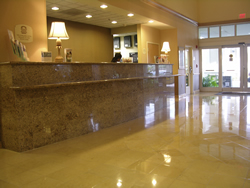
Such is the case for one Kinseth Hospitality property: the Holiday Inn Hotel & Conference Center located in the heart of Rock Island, Illinois. With 175 guest rooms, nearly 10,000 square feet of convention hall space and a large, open lobby and waiting area, this Kinseth property uses Holiday Inn’s Sparkle Program to set a strict standard of cleanliness throughout the hotel. However, achieving that standard is easier said than done.

The Challenge
The constant foot traffic from occupants and conferences, large space and high standard of guest satisfaction all present a complex challenge for Holiday Inn Rock Island’s cleaning and maintenance staff. In addition, while the hotel’s vintage appearance lends itself to a comfortable, classic atmosphere, its 1964 construction makes cleaning and maintenance even more difficult. Finally, because of the always-open nature of the business, there’s little time to implement new practices and equipment.

“We don’t have a ton of time. Our business is open 24/7, 365 days a year. There’s always stuff going on. There’s always motion in the building. There’s always something,” said Connie Schlichting, Regional General Manager for Kinseth Hotels. In short, there’s a lot of space to clean, and a number of complicating factors dictating how that space can be cleaned.

The Solution
Connie turned to Advance for answers, and the team went to work. Meeting on site with Connie and her staff, the Advance team introduced seven new cleaning machines specifically selected to best suit their needs, while replacing mops, buckets and other outdated equipment.

In just a few hours, the Advance team organized and provided basic operational training to the hotel staff, and left the machines in their capable hands.

The Result
Just one month after the Advance team trained in the hotel cleaning staff, the difference wasn’t just clear—it was clean. 

Connie reported productivity boosts that reduced cleaning times up to 30%, saving anywhere from three to five minutes per room. This allowed for the same number of staff to clean more areas of the hotel in the same amount of time. But employees weren’t just cleaning faster—they reported a higher level of satisfaction with the ease of cleaning. 

Rock Island guests weren’t just pointing out how clean things were; more often they were not even noticing it at all as faster dry times meant no “Wet Floor” signs, quieter vacuums meant fewer noise complaints, and higher productivity meant staff spending less time in each area. And, thanks to the primarily battery-powered equipment, both guests and staff didn’t have to worry about the common tripping hazards presented by traditional power cords.

Perhaps the most important result that arose from the study was the high quality of cleaning itself. For example, when comparing the performance of the SC351TM micro scrubber to a traditional mop and bucket in their lobby, Connie said, “It just made it very smooth and clean all day long. We used it every day, and while you only had to use it once, the more we used it, the better our floor looked. It just keeps the shine and everything about the floor looking a lot better.”

From the quiet, lightweight and longer-corded vacuum to the fast-drying, non-streaking micro scrubber, each piece of Advance equipment used at Holiday Inn Rock Island received a glowing review. Beyond that, the cleaning performance and productivity at Holiday Inn Rock Island really speaks for itself—cleaning that people don't see to believe.

Learn more about Advance's cleaning solutions for the hospitality industry.

Monday, January 7, 2013

Sensitive Occupants: Best Cleaning Practices

This article was originally published in Contracting Profits

By: John Garrett


Whether cleaning around hospital patients, children, allergy or asthma sufferers, effective cleaning procedures are increasingly important within healthcare facilities, K–12 schools and commercial offices alike.

Consider the following: It is estimated that 180,000 cleaning professionals are injured by the commercial cleaning products they use; respiratory system irritation and burns to eyes and skin make up the majority of these on-the-job injuries; building occupants and visitors commonly complain about odors and respiratory problems associated with cleaning products and processes; some occupants have asthma and other breathing disorders that are sensitive to particles in the air, volatile organic compounds and vapors produced by the cleaning process is being used around them; volatile organic compounds (VOCs) evaporate from cleaning products before, during and after their use, contributing to poor indoor air quality; and millions of dollars are spent annually for medical expenses and lost time wages due to these cleaning product chemical injuries.

With an increase in facility occupant sensitivities, and workplace accidents and injuries, building service contractors (BSCs) and industry professionals have and will continue to trend towards the implementation of green cleaning programs, with the results including lower risks for occupants and cleaner facilities. However, is greener really cleaner?

Oddly enough, traditional cleaning products are often more dangerous than the germs they are designed to kill. Indoor air pollution is as much as 2 to 5 times higher than outdoor pollution, on average, according to the U.S. Environmental Protection Agency (EPA). The World Health Organization estimates that 30 percent of all buildings have problems with indoor air pollution, and further that 80 percent of cancers are related to environmental factors like toxins. At least one-third of cleaning products contain chemicals that are known to cause significant damage to occupants and the environment.

Studies demonstrate that chlorine bleach, ammonia and other cleaners release greenhouse gases and toxic vapors, many of which are suspected carcinogens. Hazardous chemicals have been known to remain on surfaces and/or airborne for hours, causing mild to serious symptoms including headaches, fatigue and asthma.

Green cleaning procedures are often quite similar to traditional methods. The differences are more a matter of focus and technique, and often rely upon understanding occupant needs and vulnerabilities, while incorporating the right products to mitigate exposure and unnecessary risk to those occupants.

Read the full article to learn about the best cleaning practices for cleaning sensitive facility occupants. 

Monday, April 9, 2012

Hospitality Market Cleaning

We know that your hospitality facility requires top quality cleaning. Ensure your guests are greeted with a tidy, well-maintained appearance morning, noon and night. We’ll help you make your guests feel at home, with floor cleaning solutions that keep carpet and hard floors looking their best. From everyday sweeping and vacuuming to entryway scrubbing and periodic carpet extraction, our machines help you keep up your facilities—and your reputation—to impress guests and visitors alike.

Check out what Advance has to offer for your hospitality facility cleaning: http://www.advance-us.com/industries/commercial/hospitality.aspx


Monday, November 14, 2011

Joel Moore, Director of Housekeeping from Encore at Wynn Las Vegas, Discusses Challenges Within the Hospitality Industry

Understanding the trends and cleaning challenges within the hospitality industry with Joel Moore, Director of Housekeeping from Encore at Wynn Las Vegas at the Advance ISSA 2011 booth.